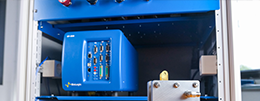
Shaping the future.With partners.
No single measurement tells the whole story of an electrochemical reaction. Combining your potentiostat with a second technique — diffraction, imaging, mass spectrometry, thermal analysis and more — lets you see structural, physical or chemical change happen in the same moment as the electrochemistry driving it, instead of inferring it afterward from separate experiments.
Each partnership below has already solved the hard part: synchronizing the two instruments and getting their data to line up. Browse by the technique you need, then compare the partners we’ve integrated it with.
Climate Chambers.
Control your test cell environment.
Temperature is one of the biggest variables in battery performance, so controlling it precisely is essential for comparable, reproducible test data. Integrating a climate chamber directly with your cycling software lets you regulate and log environmental conditions alongside electrochemical data, supporting safety testing and technology selection across a range of operating conditions.
BioLogic has made it even easier to control battery testing environments by using EC-Lab® & BT-Lab® with the TCU Server installed, users can connect and control the regulator for various climate chambers.
Binder
BioLogic’s TCU Server allows you to connect directly to Binder’s MK Series climate chambers via BioLogic’s software.
Read more
With this integration you can safely and reliably control and log the test environment for synchronized data.
RECOMMANDED WITH EC-LabBT-LabTCU Server
X-Ray Diffractometer.
Track structure while you charge and discharge.
Pairing BioLogic potentiostats with an X-ray diffractometer lets you gain not just qualitative but quantitative and microstructural information in real time as it cycles. Operando XRD experiments typically run for days and collect hundreds to thousands of diffraction patterns, so the potentiostat needs to hold precise, stable control over that whole window. In return, the diffraction data reveals phase composition, lattice distortion and volume change at each state of charge.

Bruker
The D8 ADVANCE XRD integrates with BioLogic’s SP-50e potentiostat for multi-day operando runs, capturing hundreds of diffraction patterns per experiment alongside continuous, reliable potentiometry.
Read more
Well suited to quantitative and microstructural analysis of battery materials through full charge/discharge cycles.
RECOMMANDED WITH SP-50e
Malvern Panalytical
The Empyrean diffractometer, VTEC-trans temperature control and BioLogic’s SP-50e/150e potentiostats run from one synchronized interface.
Read more
HighScore Plus software automates analysis of large scan batches, making it a practical fit for long, high-volume operando studies.
Rigaku
SmartLab’s auto-aligning battery stages support in-situ and operando XRD on coin, pouch and pressurized solid-state cells.
Read more
BioLogic potentiostats — including the SP-50e, SP-150e and SP-300 — provide the triggering that synchronizes cycling with each XRD scan.
Quartz crystal microbalance (eQCM-D).
Add physical interface insight to electrochemistry.
Electrochemical QCM-D (eQCM-D) combines electrochemical control with real-time monitoring of mass and viscoelastic changes at the electrode surface. By complementing electrochemical measurements with information about interface evolution, eQCM-D helps researchers understand processes such as deposition, dissolution, film formation, ion insertion, and interphase growth as they occur.
Applications include battery research, fuel cells, electrolyzers, corrosion studies, coatings, sensors, and other systems where interface behavior plays a critical role in performance and stability.
Biolin Scientific
Biolin Scientific’s QSense® platforms integrate seamlessly with BioLogic potentiostats, combining advanced electrochemical control with mass-sensitive and dissipation-based measurements. This approach provides a deeper understanding of how electrochemical interfaces form, evolve, and influence device performance.
Read more
Particularly well suited for studies of battery electrodes, solid-electrolyte interphases (SEI), ion exchange membranes, electrocatalysts, coatings, and corrosion processes.
RECOMMANDED WITH SP-200 AND COMPATIBLE WITH All Potentiostats
AWSensors
BioLogic potentiostats can be coupled with existing QCM-D instruments for electrochemical quartz crystal microbalance measurements, enabling researchers to combine electrochemical data with mass-sensitive interface monitoring.
Read more
Suitable for electrodeposition, corrosion studies, and surface science.
COMPATIBLE WITH Premium Potentiostats
Transmission electron microscopy.
Measure mass change at the electrode surface.
In-situ TEM makes it possible to image battery and electrode materials while a reaction is actually happening, rather than inferring structure from before-and-after snapshots. Because the electrochemical cell sits inside the microscope at micro scale, the potentiostat driving it needs to be exceptionally low-noise to keep the data clean.
Hummingbird Scientific
Hummingbird’s liquid flow cell holders, fitted with an electrochemical chip available in several configurations, connect to BioLogic’s SP-200 potentiostat for in-situ TEM.
Read more
Used to investigate corrosion, electrolysis and battery reactions, giving direct insight into ion transfer as it happens.
RECOMMANDED WITH SP-200
EC-MS.
Watch gas evolution as you apply potential.
Electrochemical mass spectrometry measures the volatile species produced by a reaction in real time, as a function of the potential applied. It’s used across electrolysis, fuel cells, battery research and fundamental electrochemistry to quantify gas evolution, revealing electrode and electrolyte degradation and how different catalysts perform.
Spectro Inlets
Spectro Inlets combines a microchip inlet, mass spectrometer and gas-handling system in one benchtop instrument, pairing with BioLogic’s SP-200 potentiostat for the sensitivity — down to 100 pA — that EC-MS demands.
Read more
Resolves composition changes down to 0.1 seconds, in both aqueous and non-aqueous electrolytes.
RECOMMANDED WITH SP-200
Microcalorimetry.
Pair electrochemical and thermal data.
Measuring heat output alongside electrochemical cycling reveals parasitic reactions that voltage and current data alone can miss — information that feeds directly into lifetime prediction, thermal management and safety testing. Running both measurements concurrently, rather than sequentially, keeps the two datasets directly comparable at every point in the cycle.

TA Waters
The Battery Cycler Microcalorimeter Solution pairs BioLogic’s VSP-300 potentiostat with TA’s TAM IV Microcalorimeter, run from a single TAM Assistant interface.
Read more
Supports coin, cylindrical and pouch formats, with up to 12 cells tested in parallel — turning what used to be weeks of testing into days.
RECOMMANDED WITH VSP-300TAM IVTAM Assistant
Don't see your technique?
We’re always looking to pair BioLogic instrumentation with new measurement techniques. Tell us what you’re working on and we’ll get back to you.
Choose your quarterly Newsletters.

General Electrochemistry / quarterly newsletter
Local Electrochemistry / quarterly newsletter

Software update release (ec-lab software, bt-lab software, .etc)
Need support?