Scanning Electrochemical Workstations
High-resolution, modular scanning workstations for local activity measurement
For over 30 years, BioLogic has been shaping scanning probe electrochemistry. From early single-technique tools to the first modular workstation — the M370 in 2006 — we’ve been driving innovation.
Our modular scanning electrochemical platforms let researchers mix and match powerful probe techniques to map local electrochemical behavior with precision. From corrosion to biology, batteries to catalysis, our systems deliver the flexibility and performance needed for today’s experiments… and tomorrow’s.
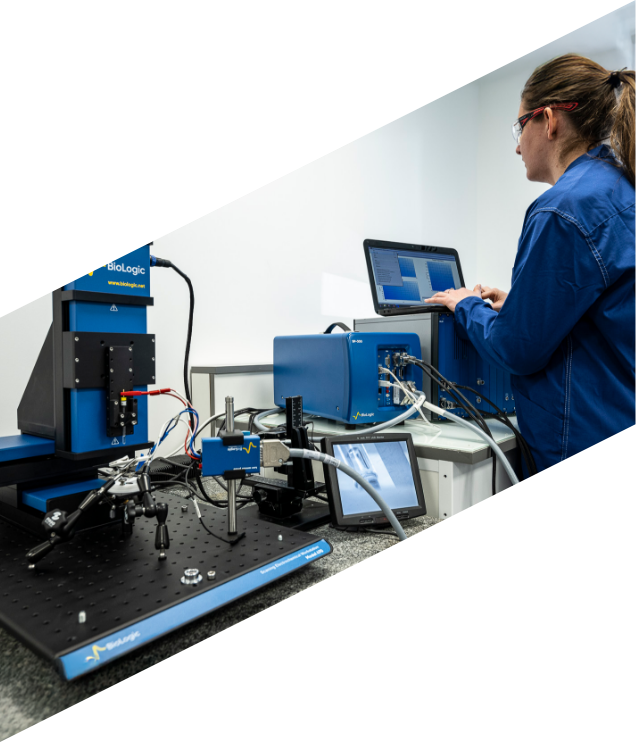
What is scanning probe electrochemistry?
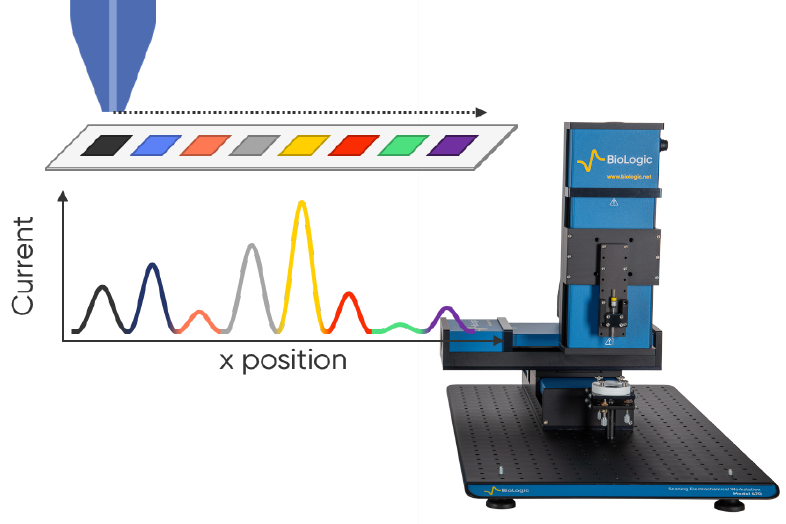
Scanning probe electrochemistry encompasses a range of techniques combining electrochemistry and microscopy. Bulk electrochemistry allows the investigation of global processes; however, it is an average of the sample and does not necessarily indicate the cause of such bulk processes. Conversely, with microscopy, surface features can be measured, but the effect of these features is not clear. Scanning probe electrochemistry gives users a “best of both worlds” approach locally mapping the electrochemistry of a sample.
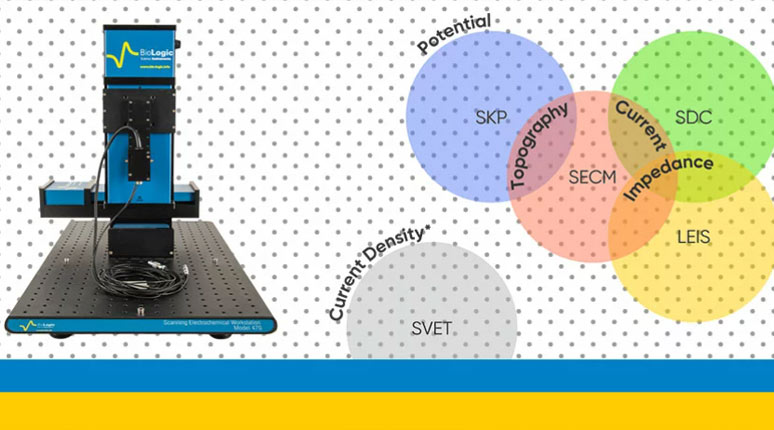
Through scanning probe electrochemistry, a correlation between activity and features can be made. Scanning probe electrochemistry techniques available from BioLogic include:
- Scanning Electrochemical Microscopy (SECM)
- Localized Electrochemical Impedance Spectroscopy (LEIS)
- Scanning Vibrating Electrode Technique (SVET) (also known as vibrating probe)
- Scanning Kelvin Probe (SKP)
- Scanning Droplet Cell (SDC)
- Optical Surface Profiler (OSP)
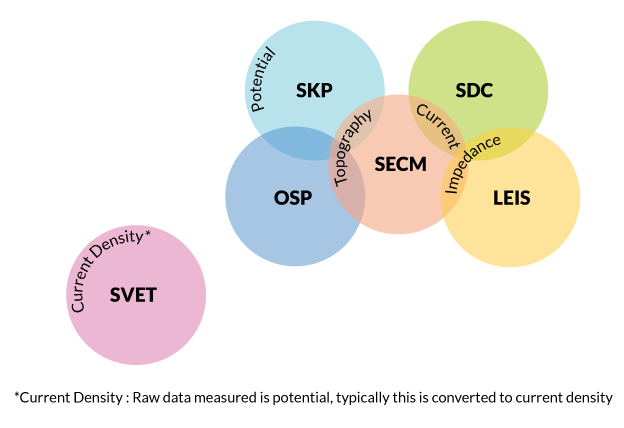
Scan area & resolution: Selecting the right technique
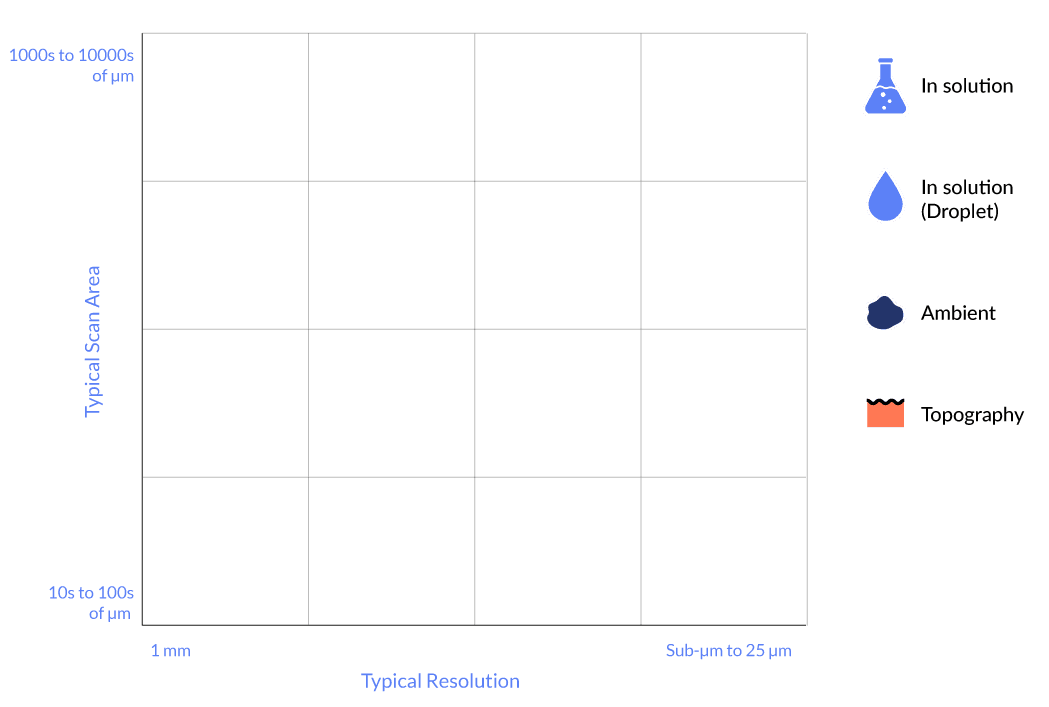

LEIS
SVET
ic-SECM
ac-/dc-SECM

SKP

OSP

ac-/dc-SDC
Local Electrochemical Impedance Spectroscopy (LEIS) is used to measure point by point EIS, or to map the local impedance of a bare or coated sample at a single frequency. It is particularly relevant for corrosion studies.
Scanning Vibrating Electrode Technique (SVET) also known as Vibrating Probe) is used to measure the local current distribution of a naturally active, freely corroding, or biased sample in solution.
Intermittent Contact (ic)-SECM is a constant distance SECM option. In a single pass experiment ic-SECM maps both sample activity (dc-ic-SECM) or impedance (ac-ic-SECM) and topography.
Scanning Electrochemical Microscopy (SECM) is used to map the local activity (dc-SECM) or impedance (ac-SECM) of a sample. It has the highest resolution of the local electrochemistry techniques,
Scanning Kelvin Probe (SKP) maps the local Contact Potential Difference (CPD) of a sample in ambient conditions. It is straightforward to convert the CPD to the Corrosion Potential (ECORR), or Work Function (WF).
The Optical Surface Profiler (OSP) is a non-contact, non-destructive topography mapping technique. It can be used as a standalone experiment or combined with other local electrochemistry techniques.
Scanning Droplet Cell (SDC) confines an electrochemical cell to a droplet which can be moved across the sample to map the surface or perform local electrochemistry or Electrochemical Impedance Spectroscopy (EIS) experiments.
Local Electrochemical Impedance Spectroscopy (LEIS) is used to measure point by point EIS, or to map the local impedance of a bare or coated sample at a single frequency. It is particularly relevant for corrosion studies.
Scanning Vibrating Electrode Technique (SVET) also known as Vibrating Probe) is used to measure the local current distribution of a naturally active, freely corroding, or biased sample in solution.
Intermittent Contact (ic)-SECM is a constant distance SECM option. In a single pass experiment ic-SECM maps both sample activity (dc-ic-SECM) or impedance (ac-ic-SECM) and topography.
Scanning Electrochemical Microscopy (SECM) is used to map the local activity (dc-SECM) or impedance (ac-SECM) of a sample. It has the highest resolution of the local electrochemistry techniques,
Scanning Kelvin Probe (SKP) maps the local Contact Potential Difference (CPD) of a sample in ambient conditions. It is straightforward to convert the CPD to the Corrosion Potential (ECORR), or Work Function (WF).
The Optical Surface Profiler (OSP) is a non-contact, non-destructive topography mapping technique. It can be used as a standalone experiment or combined with other local electrochemistry techniques.
Scanning Droplet Cell (SDC) confines an electrochemical cell to a droplet which can be moved across the sample to map the surface or perform local electrochemistry or Electrochemical Impedance Spectroscopy (EIS) experiments.

Local Electrochemical Impedance Spectroscopy (LEIS) is used to measure point by point EIS, or to map the local impedance of a bare or coated sample at a single frequency. It is particularly relevant for corrosion studies. ... Read more
Scanning Vibrating Electrode Technique (SVET) also known as Vibrating Probe) is used to measure the local current distribution of a naturally active, freely corroding, or biased sample in solution. ... Read more
Intermittent Contact (ic)-SECM is a constant distance SECM option. In a single pass experiment ic-SECM maps both sample activity (dc-ic-SECM) or impedance (ac-ic-SECM) and topography. ... Read more
Scanning Electrochemical Microscopy (SECM) is used to map the local activity (dc-SECM) or impedance (ac-SECM) of a sample. It has the highest resolution of the local electrochemistry techniques, ... Read more
Scanning Kelvin Probe (SKP) maps the local Contact Potential Difference (CPD) of a sample in ambient conditions. It is straightforward to convert the CPD to the Corrosion Potential (ECORR), or Work Function (WF). ... Read more
The Optical Surface Profiler (OSP) is a non-contact, non-destructive topography mapping technique. It can be used as a standalone experiment or combined with other local electrochemistry techniques. ... Read more
Scanning Droplet Cell (SDC) confines an electrochemical cell to a droplet which can be moved across the sample to map the surface or perform local electrochemistry or Electrochemical Impedance Spectroscopy (EIS) experiments. ... Read more
M470.
Modular Scanning Electrochemical Workstation
Customizable with up to 9 local electrochemistry techniques.
- Technique
- Sample
- Typical resolution (probe dependent)
- Electrolyte
- Local Electrochemical Impedance Spectroscopy (LEIS)
> Read more - Suitable samples include coated metals, bare metals, conductors, and semiconductors. The sample must be the working electrode.
- 1 mm
- Sample completely immmersed in low conductivity electrolyte
- Scanning Droplet Cell (SDC)
> Read more - Suitable samples include bare metals, conductors, semiconductors. The sample must be the working electrode.
- 100 µm to 1 mm
- Sample exposed to droplet of electrolyte
- Scanning Kelvin Probe (SKP)
> Read more - Suitable samples include coated metals, bare metals, conductors, semiconductors, biological samples. The sample must be an electrode.
- 150 to 500 µm
- Measurements in air. No electrolyte.
- Scanning Vibrating Electrode Technique (SVET)
> Read more - Suitable samples include bare metals, conductors, semiconductors, biological samples. The best signal is achieved if the sample is an electrode.
- 100 to 200 µm
- Sample completely immmersed in low conductivity electrolyte
- Optical Surface Profiler (OSP)
> Read more - All samples
- 30 µm
- Measurements in air. No electrolyte.
- Scanning Electrochemical Microscopy (SECM)
> Read more - Suitable samples include coated metals, bare metals, conductors, insulators, biological samples. The sample can be a second working electrode.
- Sub-µm to 25 µm
- Sample is completely immersed in electrolyte. A redox mediator may be added to electrolyte (dc-SECM).
- Intermittent Contact-Scanning Electrochemical Microscopy (ic-SECM)
> Read more - Suitable samples include coated metals, bare metals, conductors, insulators. The sample can be a second working electrode.
- 10 to 25 µm
- Sample is completely immersed in electrolyte. A redox mediator may be added to electrolyte (ic-dc-SECM).
Why choose BioLogic Scanning Electrochemical Workstation?
Completely Modular and Upgradable
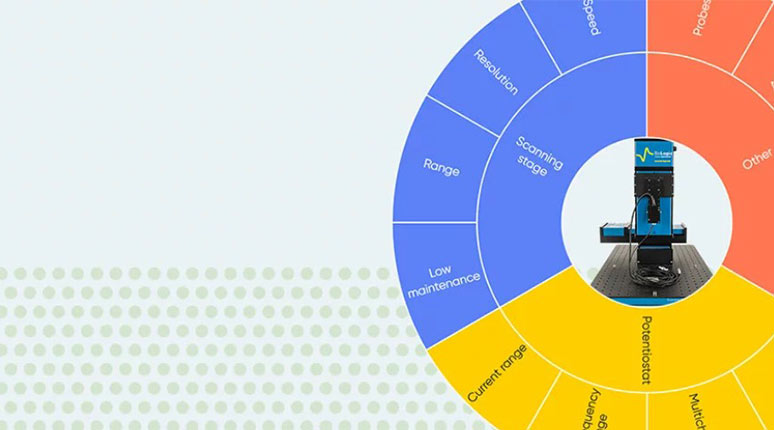
The M470 is BioLogic’s fourth-generation scanning probe electrochemistry platform, offering unmatched flexibility. With seven modules enabling nine techniques, it delivers everything from topography to electrochemical activity in one compact system. Its modular design lets researchers add new capabilities as needed, without increasing the instrument’s footprint. A full range of probes and accessories completes the toolkit for tailored experimentation.
High-resolution, high-accuracy scanning stage
The M470 scanning stage is engineered for precise scanning probe electrochemistry. Its closed-loop system delivers high-resolution, high-accuracy, repeatable motion with no hysteresis, no axis twist, and no cross-talk — ensuring clean measurements free of positioning artefacts.
Sweep scan with height tracking
Constant-height scanning only works on flat samples. For real-world surfaces with topography, the M470’s height-tracking mode adjusts the probe in Z based on a pre-measured surface map, enabling constant-distance measurements on uneven samples. With the new sweep-scan height tracking, these measurements are now as fast as standard constant-distance scans and available across all DC techniques: dc-SECM, dc-SDC, SKP, and SVET.
SECM tilt compensation over entire range
In SECM, the measured signal is extremely sensitive to probe–sample distance, and even slight sample tilt can cause signal decay. Mechanical leveling is possible but slow, so the M470 now integrates automatic tilt compensation using the Approach Curve Topography Extrapolation experiment. This flexible method works across the full X,Y range, ensuring consistent SECM measurements regardless of sample size or tilt.
Powered by BioLogic potentiostats
The M470 has been designed to fully exploit the numerous advantages of the BioLogic SP-300 potentiostat and its benchmark EC-Lab control/analysis interface. Low current range (100 pA to 1 A) ensures nA currents common in SECM, can be accurately measured without significant noise.
All in one software
The M470 software has been designed to include everything needed during the workflow of almost all scanning probe electrochemistry experiments. Through a single software, users can position the probe, run both bulk and local electrochemistry experiments, and analyse and process the resulting data. This avoids the need for users to swap back and forth between software to perform a full scanning probe electrochemistry experiment.
FAQ.
What technique is best for my application?
BioLogic offers five distinct scanning probe electrochemistry techniques, some of which include multiple modes, to offer the widest flexibility in the signal measured. This flexibility, however, requires understanding which technique is best suited to your samples. When deciding which technique to use it can be useful to answer the following questions:
- Is a particular signal of interest?
- Can an electrical connection be made to the sample?
- What is the sample type?
- Can the sample be exposed to electrolyte?
- What is the size of the scan area of interest?
- What resolution is acceptable?
It is of course important to keep in mind that in some cases multiple techniques will be applicable.
You can learn more about selecting the best technique(s) on our Learning Center. Our sales team is always on hand to provide personalized recommendations. They have extensive experience across diverse fields (such as batteries, fuel cells, corrosion…) and would be happy to guide you through the selection process.
How to choose a Scanning Electrochemical Workstation?
A scanning electrochemical workstation is a long-term investment, which can commonly still be in use 10 to 15 years after installation. It is therefore understandable to carefully evaluate a scanning electrochemical workstation before selecting the best one for you.
When evaluating a scanning electrochemical workstation, it can be useful to consider:
- Available techniques
- The potentiostat
- The scan head
- The probes and accessories available
- The software ergonomics
- Who will be using the scanning electrochemical workstation
- The level of maintenance required
- The level of support available
For more detailed information on the different factors you should take into account when purchasing a scanning electrochemical workstation please see our Learning Center article “Key factors to consider when looking for a scanning electrochemical workstation.” And for the optimal solution, we strongly recommend contacting our sales team, who can provide personalized recommendations based on your application needs. They have extensive experience across diverse fields (such as batteries, fuel cells, corrosion…) and would be happy to guide you through the selection process.
Can I include multiple techniques?
The M470 is a fully modular instrument. At time of purchase, it can be configured with any number of modules available to create anything from a single technique to a full multi-technique instrument (with seven modules for nine technique types). Furthermore, the modular nature means that as needs evolve over time, researchers can upgrade the M470 with any of the available techniques.
For further information, and help configuring your instrument we advise contacting our sales team.
Can I use my existing potentiostat?
The M470 has been designed to work with BioLogic’s premium potentiostats. It can be used with new and existing potentiostats.
Because of variations in the different scanning probe electrochemistry technique, the specific configuration of the premium potentiostat can vary. Our sales team will always help ensure you have the correct configuration for your scanning needs, whether this is on a new or existing potentiostat.
How important is the driver type for the scan head?
There is sometimes the misconception that the driver type (piezo, stepper motor, etc.) used for the scanning axes is the most important factor in the quality of the scanning electrochemical workstation scan head. The drive is only one part in the components required to build a scan axis which affects its accuracy and resolution. By optimizing all the mechanical components (moving device, stage head, and drive) and the position measurement and control device, it is possible to achieve a high accuracy and high-resolution scan head.
Can I perform constant distance measurements?
Constant distance measurements are possible using BioLogic’s scanning probe electrochemical workstations. The options available for performing constant distance measurements is dependent on the scanning probe electrochemistry technique of interest.
When performing constant distance Scanning Electrochemical Microscopy (SECM) users can perform a single pass experiment using the Intermittent Contact (ic)-SECM technique. With ic-SECM it is possible to measure both sample topography and sample activity (without the effect of topography) at the same time.
With all other techniques it is possible to perform constant distance measurements by first measuring the sample topography and then using this to perform a height tracking experiment to follow the topography throughout. Topography can be measured with Optical Surface Profiler (OSP) technique, Scanning Kelvin Probe (SKP), or ic-SECM.
Can I perform tilt correction?
Although all the cells available for BioLogic’s scanning probe electrochemical workstations, offer the possibility to level the cell to remove tilt prior to the measurement this is not always enough. With this in mind there are two methods available to account for sample tilt.
When dc- or ac-SECM is used the Approach Curve Topography Extrapolation Experiment can be used. This experiment utilises approach curves to determine the sample tilt prior to measurement, which can then be followed in the SECM measurement using height tracking.
For all technique types sample tilt can also be accounted for using the tilt correction function available in the post processing software tools.
Does BioLogic offer technical support and training?
We offer comprehensive technical support and training for our users:
- Included technical support (Request a support – BioLogic)
- Extensive documentation including Application Notes, Learning Center articles and a personal space with exclusive support resources after instrument registration
- Regular online webinars covering advanced techniques and research topics
- On-site and online training programs tailored to your needs
- Installation assistance to ensure smooth setup
How can I register my instrument?
Click here to register your instrument(s), please register using your instrument serial number (located on the rear panel of the device). Upon submission, we’ll provide you with a personalized access code that unlocks a dedicated space featuring comprehensive support resources available only to those with a my.biologic.net account.
How do I request support?
For any support request, contact your local retailer or click here to access the support contact form. Our highly qualified support engineers are ready to assist you.
Detailed documentation is available on our website and in your personal space upon registration.
Here is helpful information to provide when contacting our support center:
- Serial number of the instrument (located on the rear panel of the control unit, or available in the software by clicking on Help, and then About)
- Software version you are currently using (In the software click Help, and then About)
- Operating system in the connected computer
- Description of the error (the error message, the experiment file, picture of settings or any other useful information) and of the context in which the error occurred. Try to remember all steps you had performed immediately before the error occurred. The more information on the actual situation you can provide, the easier it is to track the problem.
Scanning Probe Electrochemistry Newsletters A series showcasing real-world applications of Scanning Probe Electrochemistry, covering corrosion, energy-related materials, and advanced electrochemical screening through practical case studies and technical insights.
See more articles on our Learning Center.
 Read the article
Key factors to consider when looking for a scanning electrochemical workstation.
Factors of interest when looking at a scanning electrochemical workstation are discussed.
- Read the article
Scanning Probe Electrochemistry: A glossary of terms
What do the different terms relating to local electrochemistry mean? This article gives a definitive list
 Read the article
What scanning probe electrochemistry platform is best for high throughput screening?
The article explains how to select the best high throughput workstation
- Read the article
Which scanning probe electrochemistry technique?
The scanning probe electrochemistry techniques on the M470 are compared.