Conversion of SKP CPD
Latest updated: September 16, 2026The raw data measured in Scanning Kelvin Probe (SKP) is Contact Potential Difference (CPD), which is the potential difference between the SKP probe and sample, it is also commonly referred to as the Volta potential. Although this value is relevant on its own, and is commonly reported in the literature, it can be useful to convert it to other values of interest including corrosion potential and work function. To convert the CPD to either Corrosion Potential (ECORR) or work function the SKP probe must be calibrated against a known reference sample.
Corrosion Potential (ECORR)
SKP is of interest to map the local ECORR of a sample under ambient conditions. When ECORR is of interest it is necessary to convert the measured CPD through calibration of the probe used in the measurement. The procedure to convert CPD to ECORR was introduced by Stratmann et. al. [1,2], and is explained in detail in SCAN-Lab TN#3 [3]. Briefly the SKP probe is calibrated by measuring the Open Circuit Potential (OCP) of a series of metals (in TN#3 Fe, Cu, and Zn are used) and plotting this against their measured CPD. The resulting plot follows the relationship:
$$\text{OCP} = K+\text{CPD} \tag{1}$$
Where OCP and CPD are in V, and $K$ is the conversion factor of interest, found from the intercept of the straight-line plot. An example of the straight-line plot used to calibrate the SKP probe is shown in Fig. 1.
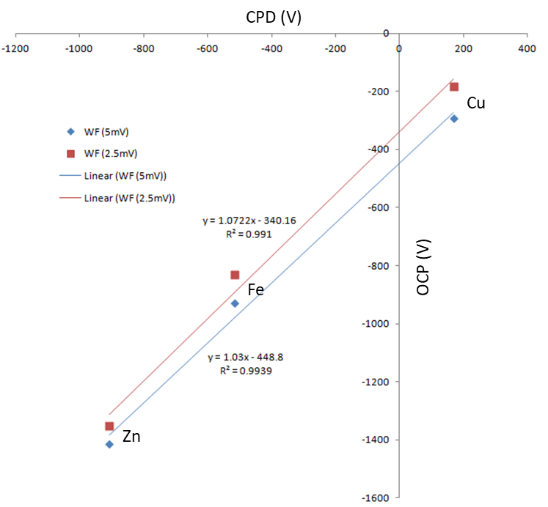
Figure 1: Straight-line plot used to calibrate an SKP probe for ECORR at two different measurement sensitivities (5 mV and 2.5 mV).
Work function
In materials and photovoltaics studies SKP is of particular interest to determine and locally map the work function of a sample. As with ECORR it is first necessary to calibrate the SKP probe in order to convert the measured CPD to work function. Calibration must be performed against a sample with a well-documented work function, and follows the equation [4]:
$$WF_\text{sample} = WF_\text{Tip} + \text{CPD} \tag{2}$$
While it is possible to use KCl solutions with a well-defined reference electrode (e.g. Ag/AgCl) as a calibration standard [5, 6] with the CPD of the electrolyte surface measured, the vapor can cause inconsistencies in the original calibration measurement so it has fallen out of favor. More commonly Highly Ordered Pyrolytic Graphite (HOPG) is used as the reference material, which has been shown to be a better choice due to it being a solid sample [6]. An example of a SKP measurement which has been converted to work function using a HOPG reference is shown in Fig. 2.
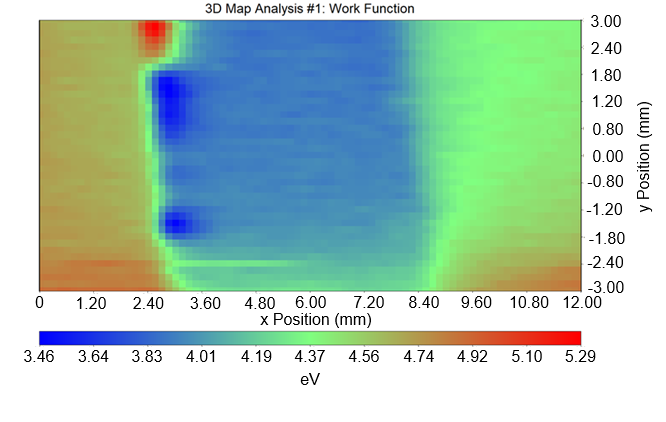
Figure 2 : Work function map of Cu/Zn/Fe sample (left to right) measured by SKP
How to apply the conversion to the map?
The SKP map produced by the M470 can be converted to the work function through simple mathematical functions. In this case the “Add value” option can be selected from the Analysis Functions menu, Fig. 3.
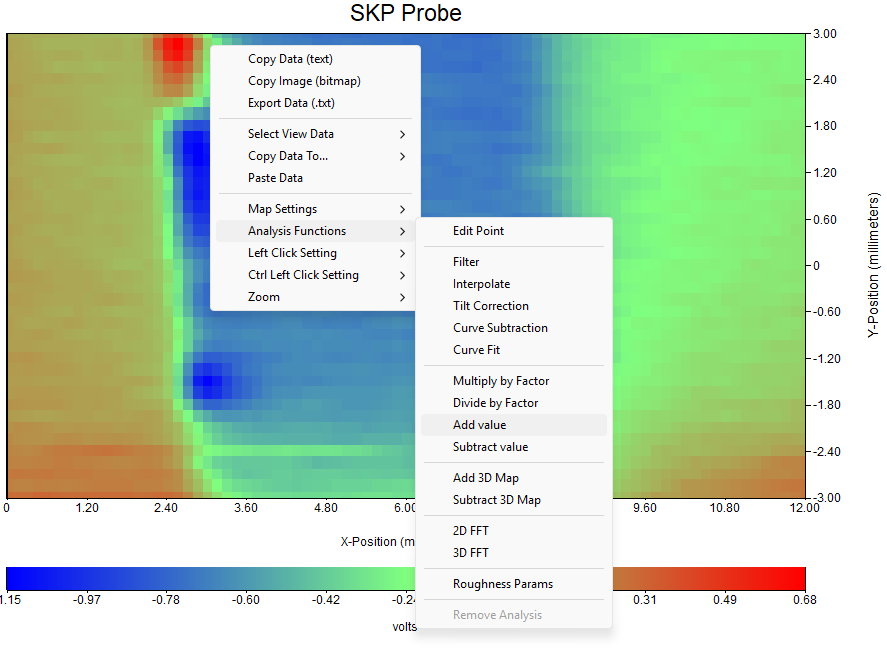
Figure 3: The “Add value” option in the “Analysis Functions” menu used to convert the M470 SKP map after calibration
The map can then be updated to reflect the new Z variable by selecting “Set Units and Title” from the “Map Settings” menu, Fig. 4.
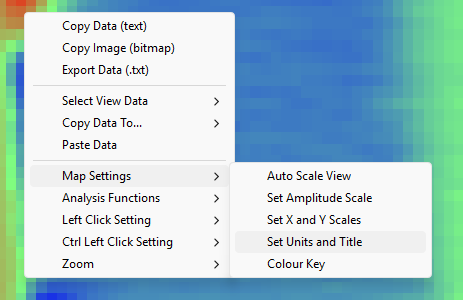
Figure 4: The “Set Units and Title” option from the “Map Settings” menu.
“A Title” and “A Units” should be updated to match the conversion performed. Fig. 5 shows this window for Work Function.
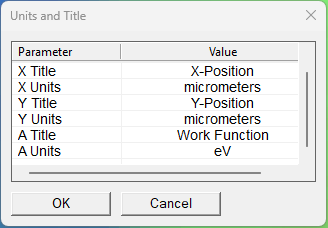
Figure 5: The “A Title” and “A Units” can be updated to match the conversion performed.
Conclusion
While the CPD measured by SKP is a relevant value in itself, it is commonly converted to corrosion potential or work function depending on the application. Common methods for this conversion have been introduced, though for further detail please consult the references. With the calibration factor found it is possible to convert the raw output map from the M470 to the map of interest within the software, as demonstrated in the final section.
References:
- Stratmann, H. Streckel, Corrosion Science 30 (1990) 681-696
- Stratmann, H. Streckel, Corrosion Science 30 (1990) 697-714
- SCAN-Lab Technical Notes 03: Relating Work Function Difference Measured by Scanning Kelvin Probe (SKP) to Corrosion Potential
- Robinson Brown, M. T. Brumbach, S. Smith, J. Ihlefeld, Improving Kelvin probe work function reliability, 28th Rio Grande Symposium on Advanced Material, Albuquerque, New Mexico (2016)
- N. Hansen, K. B. Johnson, Surface Science 316 (1994) 373-382
- N. Hansen, G. J. Hansen, Surface Science 481, 3 (2001) 172-184