How to select current range (I Range)?
Latest updated: December 22, 2025The current range (I Range) in a potentiostat defines the sensitivity and resolution with which current is applied and measured during electrochemical experiments. Selecting the appropriate I Range is important when optimizing measurement settings.
Current Ranges in EC-Lab®
The I Range setting enables users to select the appropriate current range of potentiostat: it should match the expected current levels in their measurement. On EC-Lab® software, for both potentiostatic (current measurement) and galvanostatic (current control) mode, three types of current range managements are available:
- Fixed: Selected when the expected current amplitude is known.(Refer to Figure 1)
- Auto: Automatically adjusts to the measured current when its amplitude is unknown.
- Auto Limited: Designed for experiments with currents varying across multiple ranges. Users define the maximum, minimum, and initial I Range in the “Edit I Range Limits” window.
Selecting an appropriate current range impacts the signal-to-noise ratio, measurement resolution, and the potentiostat’s ability to respond to rapid current changes.
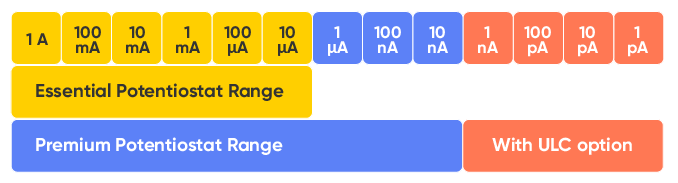
Figure 1: Current range for Essential and Premium potentiostats
Note: Autoranging is also possible with internal booster Premium boards and external Essential boosters up to 20 A.
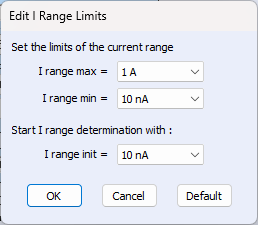
Figure 2: Auto Limited window
Note: To go further , you might want to read how current range and bandwidth are connected and can influence the response time of a potentiostat with this Application Note and this Technical Note (you will need to login to my.biologic to access Technical Notes).
Fixed range vs. Autoranging
- Fixed Range: Offers a constant sampling rate and faster response, ideal for experiments requiring precise kinetics, CASP or pulse techniques. It avoids the lag associated with automatic adjustments and ensures accurate current tracking.
- Autoranging: Provides convenience for exploratory experiments or highly variable currents. It is particularly useful in battery testing or corrosion studies where current spans multiple ranges. This is the case during PEIS and GEIS-AA experiment for example. When autoranging is enabled, data points are not acquired during a current range switch. This is usually imperceptible as autoranging is optimized.
Note: In some cases, for voltamperometric techniques, when autoranging is used, the first recorded data point may not match the setpoint due to range adjustments. To avoid this effect, it is recommended to use the Auto Limited current range and set an appropriate initial current range with the expected value.
How do I select current ranges?
Best Practices
- Estimate expected current: Use prior data, theoretical calculations, or literature to predict current amplitude.
- Select Fixed Ranges, the smallest one, when possible: Ensures a constant sampling rate and rapid potentiostat response.
- Use Auto or Auto Limited Ranges when necessary: Recommended when current varies widely, such as in battery cycling, corrosion studies or impedance techniques (PEIS and GEIS-AA).
Conclusion
Proper current range selection balances measurement accuracy, sampling rate, and experimental convenience. Fixed ranges provide stability and rapid response, while autoranging accommodates unknown or highly variable currents it may introduce transient artifacts. Understanding these trade-offs ensures optimal data quality and reliable electrochemical measurements.
You can find here other guidelines for obtaining high quality measurements.